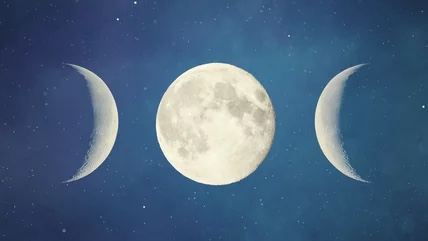
There has always been something mysterious about the moon. Ever-changing, it comes and goes through our life at a rapid pace, marking the weeks and months with its evolution. The moon is also a powerful force. Through gravity alone, it moves the water in our world’s oceans, creating high and low tides (via NASA). And just as the moon exerts its pull on the sea, it can affect us astrologically as it moves through its cycle.
Unlike occurrences like Mercury retrograde, which tend to affect us in very external ways, the moon’s phases often move us internally. In your unique astrological chart, your moon sign represents your inner self and emotional landscape. It is tied to your intuition and subconscious and may connect deeply to hidden parts of your personality. So as the moon progresses through its celestial orbit, these are the aspects most responsive to the shifting energy of its journey. Roughly every 29.5 days, the moon moves from total shadow — known as a new moon — to complete, silvery-white visibility at the full moon (via Almanac). At each of these major endpoints, you may feel an especially strong lunar influence on your life, impacting your energy levels, moods, and personal growth. But what should you really expect from these opposing moon phases, and how does full moon energy differ from new moon energy?
Standing at the beginning of the moon’s path, the shadow of a new moon represents beginnings and fresh starts (via AstroStyle). With nowhere to go but up, the new moon often positions you at a place of great potential, while its darkness provides a safe and intimate space for self-reflection. This is a time for preparation, contemplation, and the planting of new seeds — whether that means beginning a project, seeking new relationships, or embracing a good habit.
Read More: https://www.glam.com/1029957/whats-the-difference-between-full-moon-and-new-moon-energy/
 ॐDebie Lee's🪷Healthy Living Mindfulness ॐ
Leave a comment